EDOF vs Multifocal IOL – Which Lens to Choose for Your Lifestyle?What is an EDOF intraocular lens and who can benefit from it
What is an EDOF intraocular lens and who can benefit from it
READ TIME 9 MINS | ON NOVEMBER 14, 2025 | BY BIOTECH
Choosing the right intraocular lens (IOL) after cataract surgery can significantly impact your quality of life and visual independence. Extended Depth of Focus (EDOF) and Multifocal IOLs represent premium options for patients seeking reduced dependence on glasses. This comprehensive comparison will help you understand which premium IOL might better align with your specific lifestyle needs and visual expectations.
Understanding Your Premium Lens Options: EDOF and Multifocal Explained
Cataract surgery has evolved from removing cloudy lenses to a refractive procedure that can potentially eliminate the need for glasses. Cataracts are now considered a leading cause of vision loss worldwide, and the number of patients is steadily increasing with the aging population. This makes choosing lenses a crucial decision for millions of people considering cataract surgery.
Multifocal IOLs feature a distinctive design with concentric rings or steps set to different focusing powers. When light enters the eye, it splits among these rings to create multiple focal points, allowing patients to see clearly at various distances—typically near and far, with some newer designs also providing intermediate vision. This simultaneous vision approach effectively creates multiple images that the brain learns to interpret appropriately. The design complexity varies between bifocal (two focal points) and trifocal (three focal points) options.
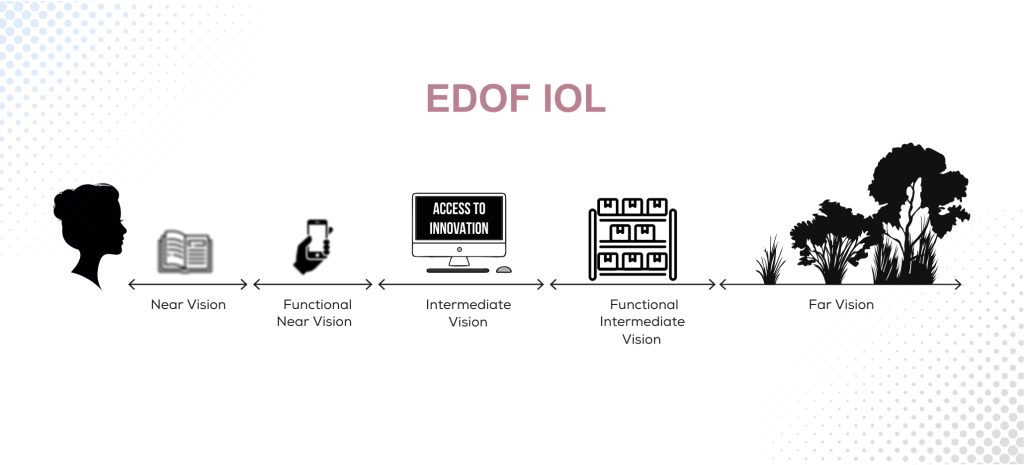
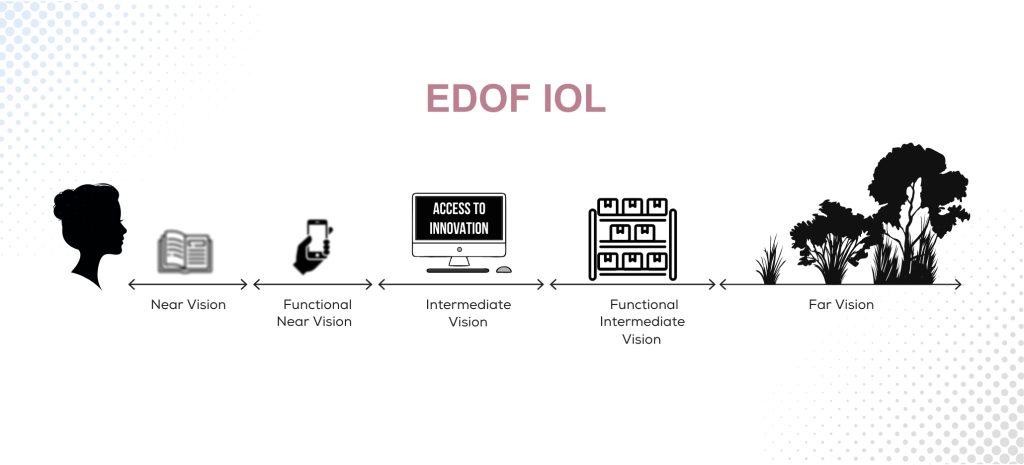
EDOF lenses employ innovative optical technology to create an elongated, continuous focal range rather than distinct focal points. These lenses use diffractive, nondiffractive wavefront-shaping,refractive or small-aperture (pinhole) optical principles to achieve an extended depth of focus. Unlike multifocals that split light into distinct focal points, EDOF lenses stretch the focus to create a seamless transition zone that covers intermediate distances while maintaining good distance vision.
The fundamental difference between these premium lens options lies in their approach to focusing light. Multifocal IOLs divide incoming light to create distinct focal points at set distances, while EDOF lenses manipulate light to create an extended range of vision without distinct transitions. This difference directly impacts visual quality, adaptation period, and potential visual disturbances.
Vision Quality Comparison: What You’ll See with Each Lens Type
Visual outcomes between EDOF and multifocal IOLs differ significantly in terms of clarity, contrast sensitivity, and range of focus. Multifocal lenses typically provide excellent near and distance vision with more defined focal points, making them ideal for patients who require crisp vision for reading small print and detailed distance viewing. However, this optical design comes with trade-offs in contrast sensitivity, particularly in low-light conditions.
EDOF lenses prioritize a continuous range of vision with particular strength in distance and intermediate zones (computer screen distance), with some designs offering functional near vision as well.
Contrast sensitivity (the ability to distinguish an object from its background) can vary among different IOL designs. Multifocal IOLs, due to their light-splitting optics, may slightly reduce contrast sensitivity, which can negatively impact vision in dim lighting conditions. A 2023 study by Tabuchi and colleagues reported that EDOF lenses offer better contrast sensitivity and intermediate vision performance compared to traditional diffractive bifocal IOLs. Therefore, EDOF lenses are considered a potentially more suitable option for patients who frequently drive at night or engage in activities requiring good vision in low-light environments.
The visual adaptation period also differs between these lens technologies. Multifocal IOLs typically require a longer neuroadaptation period as the brain learns to interpret multiple images simultaneously. EDOF lenses tend to offer a shorter adaptation period with fewer visual disturbances during the initial adjustment phase, though this varies among patients and lens models.
Lifestyle Match: Finding Your Perfect Lens
Selecting between EDOF and multifocal IOLs requires careful consideration of your daily activities and visual priorities. Multifocal IOLs are particularly well-suited for individuals who regularly engage in detailed near-vision tasks such as reading physical books, crafting, or other hobbies requiring excellent close-up vision. These lenses can provide sharper near vision than EDOF alternatives, potentially eliminating the need for reading glasses even for fine print.
EDOF lenses typically excel for patients with active, intermediate-distance-focused lifestyles. If your visual priorities include computer work, cooking, playing musical instruments, or socializing at dinner tables, the continuous focal range of EDOF lenses may better accommodate these intermediate-distance activities. The growing prevalence of digital screen usage in modern life has increased the importance of intermediate vision, positioning EDOF lenses as particularly relevant for contemporary visual needs.
Occupational demands should heavily influence your lens selection decision. Professionals who require exceptional night vision or contrast sensitivity—such as pilots, surgeons, or engineers examining detailed schematics—may find EDOF lenses more suitable. Conversely, accountants, editors, or avid readers who primarily focus on near vision tasks might benefit more from the stronger reading vision provided by multifocal options.
| Lifestyle Factor | Multifocal IOL | EDOF IOL |
| Reading/Near Work | Excellent | Moderate to Good |
| Computer Use | Variable (depends on design) | Excellent |
| Night Driving | More potential for glare/halos | Better contrast sensitivity |
| Adaptation Period | Longer (weeks to months) | Shorter (varies; often days to weeks) |
| Visual Disturbances | More common | Generally less frequent |
| Reading Fine Print | Superior | May require reading glasses |
| Digital Screen Work | Good with trifocal designs | Excellent across designs |
| Outdoor Activities | Good distance but more light sensitivity | Better in varying light conditions |
Side Effects and Adaptation: What to Realistically Expect
Both premium IOL types can produce visual phenomena that patients should understand before making their selection. Multifocal IOLs are more commonly associated with visual disturbances such as glare, halos, and starbursts around lights, particularly in low-light conditions. These effects occur because the concentric ring or steps design splits light into multiple focal points, creating overlapping images. While many patients adapt to these phenomena over time, some individuals may find them persistently bothersome, especially when driving at night.
Cochener and colleagues’ 2018 study, “Clinical Outcomes of a New Extended Range of Vision Intraocular Lens: Results of a Multicenter Study,” reported that new-generation Extended Depth of Focus (EDOF) lenses, particularly non-diffractive designs, have lower rates of halos and glare compared to traditional multifocal lenses. Similarly, other clinical studies have shown that EDOF lenses reduce visual side effects and increase patient satisfaction. These findings make EDOF lenses a suitable option for patients sensitive to visual phenomena (e.g., halos or glare).
The adaptation process differs between these lens types. Multifocal adaptation typically involves a neuroadaptation period during which the brain learns to selectively focus on the appropriate image while suppressing others. This process can take several weeks to months and varies among individuals. Patients should be prepared for this adjustment period and understand that optimal visual performance may not be immediate. The timing of the second eye surgery is determined by the surgeon, typically within days to a few weeks, to allow for early adaptation between both eyes.
Beyond visual phenomena, both lens types carry the standard risks associated with cataract surgery. Proper ocular surface optimization before surgery is crucial for achieving optimal outcomes with premium IOLs. Dry eye disease, in particular, can significantly impact the performance of premium IOLs and should be treated both before and after surgery to maximize visual results.
The Cost-Benefit Analysis: Making a Smart Investment in Your Vision
Premium IOLs represent a significant financial investment beyond what insurance typically covers for standard cataract surgery. When evaluating the value proposition of EDOF versus multifocal options, patients should consider not just the upfront cost, but the long-term benefits of reduced dependence on prescription eyewear. The potential savings from eliminating or reducing the need for progressive or multifocal glasses can partially offset the additional cost of premium lenses over time.
Patient satisfaction studies report high success rates with both lens types, but the nature of satisfaction varies. Recent research suggests that these differences are directly related to the patient’s lifestyle and visual habits. Many EDOF wearers value a balance between sharp distance/intermediate vision and minimal visual distortion, while multifocal wearers generally appreciate the freedom of near vision. Clinical data shows that 87% of EDOF wearers report high satisfaction with intermediate-distance activities, while 92% of multifocal wearers are satisfied with the independence they require from glasses for reading. The best satisfaction rates occur when the lens technology perfectly matches the patient’s lifestyle and visual expectations.
Both EDOF and multifocal IOLs are permanent implants designed to last a lifetime. However, patients should understand that age-related changes—such as posterior capsular opacification (PCO)—can occur over time. This condition, which causes lens capsule clouding, can be easily treated with a simple laser procedure.
The convenience of reduced dependence on glasses represents a major quality-of-life improvement that many patients find worth the investment. Activities like swimming, exercising, or simply waking up with functional vision without reaching for glasses can dramatically enhance daily comfort. For many, the psychological benefit of visual independence provides value beyond purely optical advantages.
American Academy of Ophthalmology. (2023). Extended Depth of Focus IOLs. https://eyewiki.org/Extended_Depth_of_Focus_IOLs
American Society of Cataract and Refractive Surgery. (2023). Premium IOL Technologies: Current Options and Future Developments. https://ascrs.org/publications/news/premium-iol-technologies
Cochener, B., & Concerto Study Group. (2023). Clinical outcomes of a new extended range of vision intraocular lens: International multicenter Concerto study. Journal of Cataract and Refractive Surgery. https://journals.lww.com/jcrs/Abstract/2023/01000/Clinical_outcomes_of_a_new_extended_range_of.8.aspx
Hartford Hospital. (2023). Extended Depth of Focus (EDOF) and Multifocal Lens. https://hartfordhospital.org/services/eye-surgery/departments-services/cataract-surgery/extended-depth-of-focus-edof-and-multifocal-lens
Healio. (2023). EDOF vs. multifocal: Considerations for presbyopia-correcting IOLs. https://www.healio.com/news/ophthalmology/20231004/edof-vs-multifocal-considerations-for-presbyopiacorrecting-iols
Johnson Laser Eye Center. (2023). What is the Difference Between a Multifocal IOL and an Extended Depth of Focus IOL? https://johnsonlasereye.com/what-is-the-difference-between-a-multifocal-iol-and-an-extended-depth-of-focus-iol/
Sharpe Vision. (2023). A Comprehensive Comparison of Multifocal and EDOF IOLs. https://sharpe-vision.com/blog/comparison-of-multifocal-and-edof-iols/
Tarib, I., Kasier, I., & Herbers, C. (2023). Comparison of visual outcomes and patient satisfaction after implantation of extended depth of focus and trifocal intraocular lenses. Journal of Ophthalmology. https://www.hindawi.com/journals/joph/2023/9518274/
Cochener B. et al., “Clinical Outcomes of a New Extended Range of Vision Intraocular Lens: Results of a Multicenter Study,” Journal of Refractive Surgery, 2018.
Tabuchi, H., Tanabe, H., Shirakami, T., Takase, K., Shojo, T., & Yamauchi, T. (2023). Comparison of visual performance between bifocal and extended-depth-of-focus intraocular lenses. PLoS ONE, 18(7), e0288602.
Wang, J., Luo, J., Yang, W., Ren, R., Xie, Y., Li, J., Guan, H., & Ji, M. (2024). Efficacy and comfort following the implantation of extended depth of focus, multifocal, and monofocal intraocular lenses in cataract patients. BMC Ophthalmology, 24, Article 423.
Staff. (2023, July 18). EDOF IOLs show improved contrast sensitivity and intermediate vision. Review of Optometry.