Clear Vision Without Compromises – How Modern EDOF Lenses Give You Natural Sight

EDOF Lens vs. Trifocal Lens Which One Is the Best Fit for You
READ TIME 6 MINS | ON NOVEMBER 14, 2025 | BY BIOTECH
The evolution of cataract surgery has led to remarkable innovations in intraocular lens technology, with Extended Depth of Focus (EDOF) lenses representing one of the most significant advancements. Unlike traditional options that often force patients to choose between near or distance vision, EDOF lenses create a continuous range of clear vision that more closely mimics natural sight. This guide explores how these advanced lenses work, their benefits compared to traditional options, and how they might transform your visual experience after cataract surgery.
What Makes Today’s EDOF Lenses Different from Traditional Options?
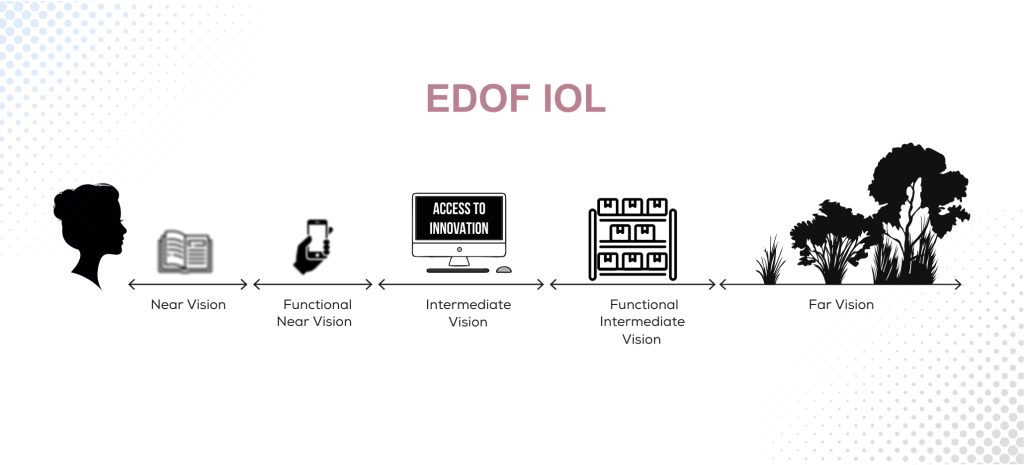
EDOF lenses feature an innovative design creating an elongated focal point rather than the single focus of standard monofocal lenses. Unlike multifocal IOLs that split light into distinct focal points, EDOF lenses elongate the focal point to create continuous vision range with fewer visual disturbances like halos and glare. Manufacturers achieve this extended focus through different approaches—diffractive optics, refractive optics, or spherical aberration manipulation—resulting in varying performance at intermediate and near distances. Patients typically adapt faster to EDOF lenses because their continuous focal range resembles natural vision more closely than multifocal lenses, usually achieving comfortable vision within 2-4 weeks instead of the 3-6 months sometimes needed with multifocal options.
The Science Made Simple: How Xtense EDOF Lens Creates Your Natural Vision Range
The Xtense EDOF lens uses advanced optical science to manipulate light waves, increasing depth of vision without creating multiple focal points. Its special refractive design with assymetric power distribution controls the transmission of light, creating an extended focal area along the visual axis.
This extended focal range mimics how young eyes naturally adjust focus between distances. While Xtense doesn’t physically change shape like a natural lens, its design creates clear vision across multiple distances while preserving contrast sensitivity and reducing optical distortions.
The Xtense lens features an advanced optical design that adapts to changing pupil sizes. Its unique segmented design with assymmetric power distribution ensures consistent visual clarity across all lighting conditions, from bright daylight to dim environments.
The specialized edge design reduces posterior capsule opacification, a common post-surgical complication that causes clouding of the lens capsule, potentially lowering the need for additional laser procedures.
Xtense technology delivers extended vision range through smooth light distribution, not multiple focal points. Unlike traditional multifocals with harsh zone transitions, it provides a more natural visual experience with fewer halos and glare..
Real Life with EDOF Lenses: What Patients Actually Experience
Patients with EDOF lenses typically experience natural vision transitions across distances. Many enjoy seamless focus from far objects to intermediate tasks like computer work, mimicking natural eyesight. This continuous clear vision varies by individual factors such as pupil size and corneal health.
EDOF lenses offer superior contrast sensitivity and fewer visual disturbances. Research shows that some EDOF designs demonstrate significantly lower light problems compared to multifocal alternatives. While only 8.8% of certain EDOF lens users report moderate-to-severe light flares, this figure rises to 34% with multifocal lenses – a significant advantage particularly for night drivers.
The patient adaptation process typically follows a predictable path. Most individuals experience immediate improvement in distance vision, while intermediate vision develops within the first few weeks. As brain adaptation progresses, visual quality continues to improve over 2-3 months, with the visual cortex learning to maximize the advantages of the EDOF design.
Daily activities become easier without constant dependence on reading glasses. Patients typically achieve excellent results for distance (driving, watching TV) and intermediate vision (using computers, cooking), but expectations for very close reading should remain realistic. Most patients can read larger text without glasses, but small print or extended reading sessions, especially in dim light, may still require reading glasses.
Reduced dependence on glasses offers meaningful social and psychological advantages. Patients with EDOF lenses often report greater self-confidence and improved quality of life. Everyday activities become more convenient without worrying about eyewear—a benefit many recipients find particularly satisfying.
Are You a Good Candidate for EDOF Technology?
Ideal EDOF lens candidates are individuals with active lifestyles who focus on intermediate-distance activities such as computer use, cooking, or shopping. These individuals value reduced dependence on glasses for daily tasks, while accepting that EDOF technology may not completely eliminate the need for glasses, especially when reading small print or in dim lighting conditions.
Successful EDOF lens outcomes depend on overall eye health. Ideal candidates have healthy corneas with minimal astigmatism, though some EDOF models can correct astigmatism. Retinal conditions like macular degeneration or advanced glaucoma may limit results. A thorough eye exam is essential to assess candidacy and set realistic expectations.
Pupil size significantly impacts EDOF lens performance. Patients with extremely large or small pupils may not achieve optimal results with certain designs. Ophthalmologists evaluate pupil diameter under various lighting conditions during preoperative assessment to determine lens compatibility. Modern EDOF lenses utilize pupil-adaptive technologies to deliver consistent visual performance across different pupil sizes. Xtense’s indifference to these variations makes it suitable for a wider range of users.
It should be noted that EDOF (Extended Depth of Focus) lenses are generally considered a better option for such patients, offering superior visual outcomes and enhanced quality of life, it requires special attention. The altered cornea affects lens performance, making detailed mapping and precise measurements essential for accurate lens calculations.
Making the Right Choice: Questions to Ask Your Surgeon
Ask your surgeon about their EDOF lens experience, including number of procedures performed and typical outcomes. Experienced doctors will openly share success rates, patient satisfaction data, and any complications they’ve encountered.
Share your daily activities, preferred working distances, and whether you drive at night or need good contrast vision. This helps your surgeon recommend the perfect lens technology for your specific lifestyle instead of offering a generic solution.
Ask about technology differences between EDOF lens models in your area. Each manufacturer uses unique optical designs, creating variations in visual performance. Some lenses work better at intermediate distances, others at close range. Understanding these differences helps you choose the right lens for your needs.
Request information about visual side effects with your recommended lens. Ask about glare, halos, and starbursts rates compared to other options. Surgeons should share comparative studies and specific data on visual disturbances between different premium lenses.
American Academy of Ophthalmology. (2023, February). Extended Depth of Focus IOLs. EyeWiki. https://eyewiki.org/Extended_Depth_of_Focus_IOLs
American Society of Cataract and Refractive Surgery. (2023). Patient Guide to EDOF Intraocular Lenses. https://ascrs.org/patients/edof-lenses
Clarisy Eye Care. (2023). Light Adjustable Intraocular lenses versus Extended Depth of Focus lenses: How do I pick?. https://clariseyecare.com/light-adjustable-intraocular-lenses-versus-extended-depth-of-focus-lenses-how-do-i-pick/
Medical News Today. (2023). Extended depth of focus (EDOF): Benefits, risks, and more. https://www.medicalnewstoday.com/articles/edof
National Center for Biotechnology Information. (2020). Extended Depth-of-Field Intraocular Lenses: An Update. https://pmc.ncbi.nlm.nih.gov/articles/PMC7299221/
Sharpe Vision. (2023). A Comprehensive Comparison of Multifocal and EDOF IOLs. https://sharpe-vision.com/blog/comparison-of-multifocal-and-edof-iols/
The Journal of Cataract & Refractive Surgery. (2022). Clinical outcomes of extended depth-of-focus intraocular lenses in cataract surgery. https://journals.lww.com/jcrs/pages/default.aspx
World Society of Cataract and Refractive Surgeons. (2023). Advances in EDOF Technology: Clinical Applications and Outcomes. https://www.wscrs.org/edof-advances